
A construction staffing agency in the Netherlands needed to modernize their hiring workflow. Their HR team managed everything in Odoo’s Applicant Tracking System, but job postings needed to appear on their WordPress website. The catch? These platforms don’t communicate out of the box, and manual synchronization wasn’t an option.
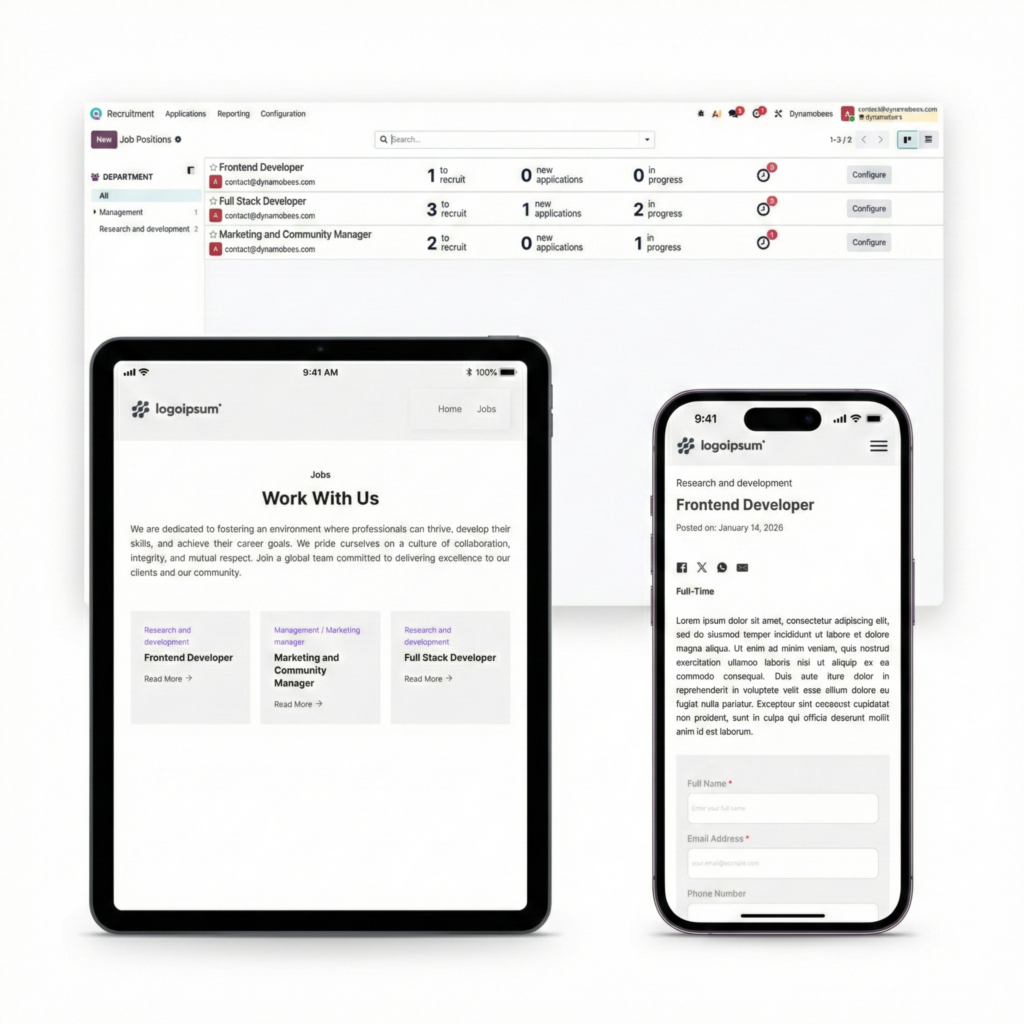
The solution involved setting up their complete Odoo Online infrastructure and developing a custom WordPress plugin to bridge both systems seamlessly.
The Core Challenge
The requirements were straightforward but technically demanding:
- Odoo as the master system – All job management happens in Odoo’s recruitment module
- WordPress for public display – Jobs automatically appear on the website
- True two-way sync – Deleting a job in Odoo removes it from WordPress immediately
- Application flow – Submissions on WordPress create candidate records in Odoo with CV attachments
- Zero manual work – No copy-pasting or duplicate data entry between systems
This goes beyond simple job listings—it’s about creating a unified workflow where HR operates from one platform while the website stays perfectly synchronized.
Why WordPress Over Odoo’s Website Builder
While Odoo includes a native website builder, the client specifically chose WordPress for their public-facing site. The reasoning was strategic:
Scalability and flexibility – WordPress offers significantly more themes, plugins, and customization options as the business grows. Adding features like blogs, landing pages, or marketing automation becomes straightforward.
Design freedom – With thousands of premium themes and page builders like Bricks, they’re not limited by Odoo’s website templates.
Separation of concerns – Keeping their internal operations (Odoo) separate from their public marketing presence (WordPress) provides flexibility to change either system independently.
The integration bridges both worlds—leveraging Odoo’s powerful recruitment features while maintaining WordPress’s presentation advantages.
Odoo Infrastructure Setup
The project began with configuring the complete Odoo Online environment from scratch:
- Recruitment module setup with custom fields created in Odoo Studio
- User permissions and access control configuration
- Job posting templates and application form customization
- HR team training on the Applicant Tracking System
Having control over both platforms allowed for an integration designed specifically around their operational needs rather than forcing existing systems to work together.
The Complete Workflow: From Job Creation to Hire
HR Creates Jobs in Odoo The hiring process starts entirely within Odoo’s recruitment module. HR staff:
- Create a new job posting with title, description, requirements, and salary range
- Assign department, location, and job type
- Set the job as “active” when ready to publish
- Add any custom fields specific to their staffing needs (years of experience, certifications, etc.)
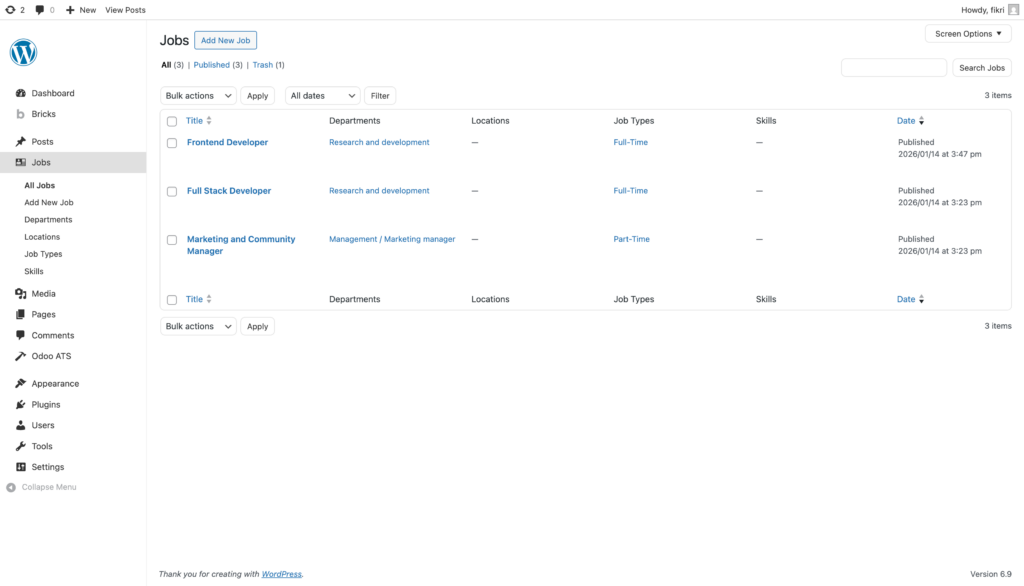
Automatic WordPress Synchronization The custom plugin functions as an intelligent bridge between both platforms. Every 5 minutes (configurable), it performs these operations:
- Connects to Odoo via secure API authentication
- Retrieves all active job postings
- Creates new WordPress posts or updates existing ones
- Automatically removes jobs deleted from Odoo
- Synchronizes job details, locations, departments, and requirements
The plugin doesn’t just mirror data—it actively reconciles both systems. If a WordPress job post exists without a corresponding Odoo record, it gets removed automatically. This ensures Odoo remains the single source of truth.
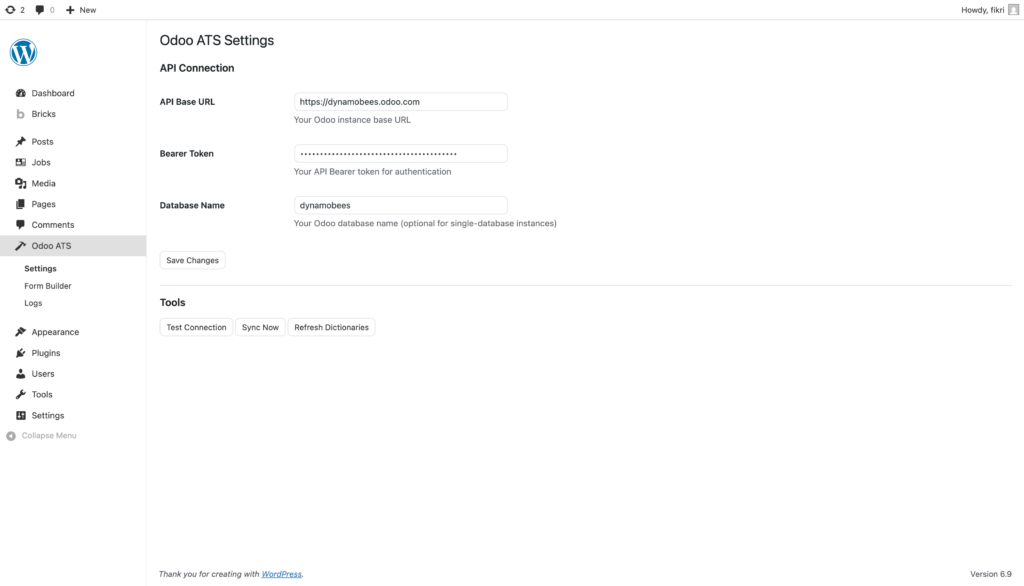
Candidate Applications When candidates submit applications through the WordPress website, the process is fully automated:
- Form validation checks information and CV file format
- A new applicant record gets created in Odoo’s recruitment system
- The CV uploads and attaches to their Odoo profile
- Submission gets logged for tracking purposes
- Candidate receives confirmation on the website
HR Reviews and Manages Back in Odoo, HR teams:
- See applications appear immediately with CVs attached
- Move candidates through hiring stages (screening, interview, offer, hired)
- Close job postings when positions are filled
- The WordPress site updates automatically to remove filled positions
This creates a seamless loop: HR works entirely in Odoo, candidates interact entirely with WordPress, and the integration keeps everything synchronized without manual intervention.
Key Technical Features
Dynamic Field Detection Since every company configures Odoo differently, the plugin automatically detects which fields exist in the database and syncs only those. Adding custom fields to Odoo later requires no code changes—the plugin adapts automatically.
Robust Error Handling Network issues and server delays are inevitable. The plugin includes automatic retry logic with exponential backoff—if a sync fails, it waits progressively longer between attempts. Temporary problems don’t break the integration.
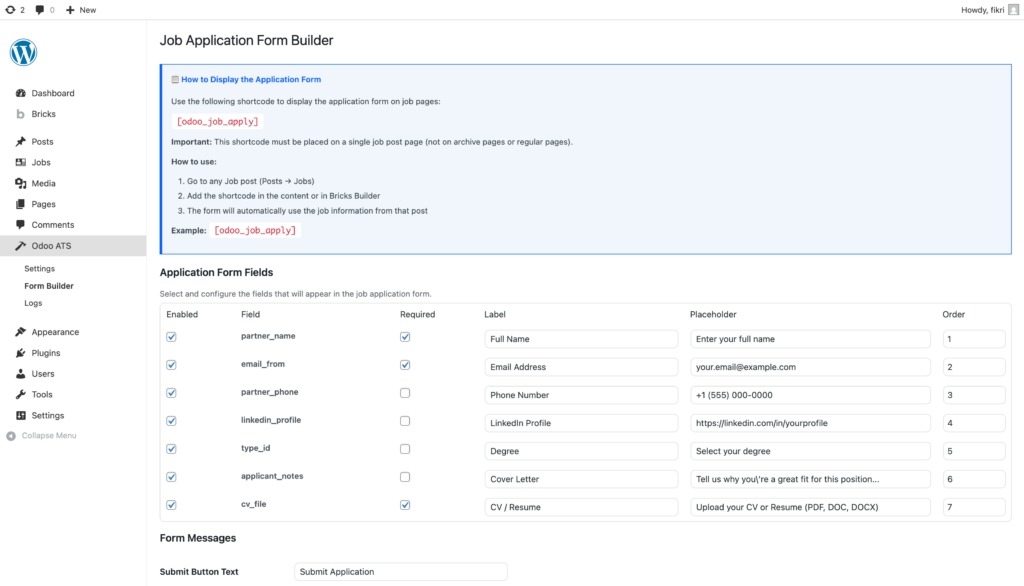
Visual Form Builder A drag-and-drop interface in WordPress allows form customization without developer assistance:
- Enable or disable fields (name, email, phone, LinkedIn, cover letter, CV)
- Modify field labels and help text
- Set fields as required or optional
- Reorder fields through drag-and-drop
Changes apply instantly to the live website.
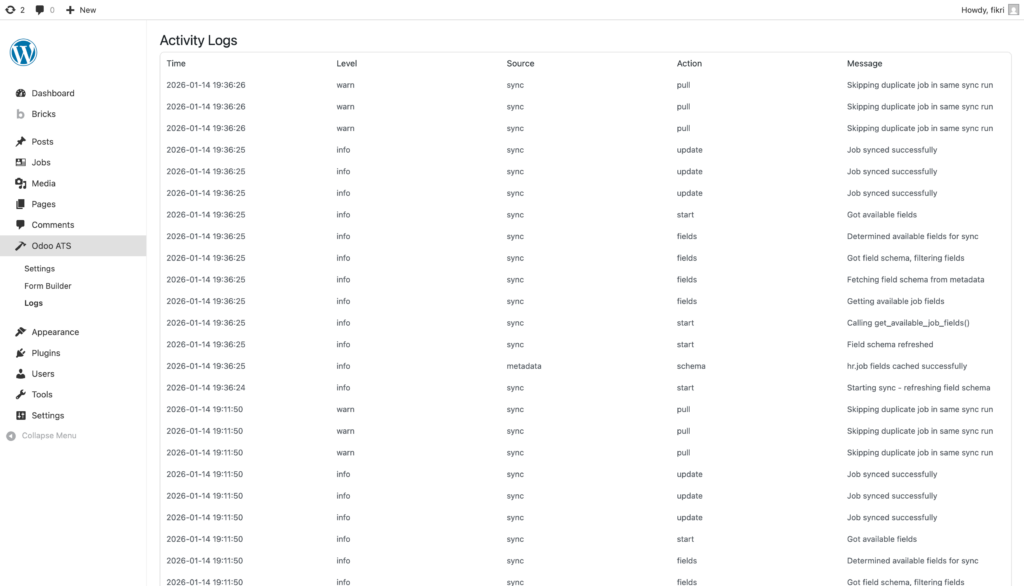
Complete Operational Visibility Every sync operation, application submission, and error gets logged to a custom database table. The admin panel provides filtering by date, event type, and severity level for easy monitoring and troubleshooting.
Development Challenges and AI-Accelerated Solutions
Building this integration presented several technical hurdles. Odoo’s API documentation contained gaps, particularly around their version 19.0 update which introduced breaking changes without clear migration paths.
To accelerate development and problem-solving, the project leveraged Claude Code—an AI-powered development assistant. This proved invaluable for:
Rapid API debugging – When encountering cryptic Odoo errors, Claude Code helped analyze response patterns and identify the breaking changes in version 19.0’s API structure.
Code generation – Complex features like the reconciliation algorithm, retry logic with exponential backoff, and dynamic field detection were developed faster with AI-generated boilerplate that could be refined and tested.
Documentation parsing – Claude Code helped navigate and synthesize information from Odoo’s extensive but sometimes unclear documentation, extracting the relevant details for authentication and file attachments.
Multiple rounds of testing with various job configurations and application scenarios helped refine the plugin to handle edge cases: duplicate submissions, network timeouts, file type validation, and maintaining data consistency across platforms.
This combination of AI-accelerated development and rigorous testing compressed what would typically be months of development into a 3-week timeline while maintaining production-quality code standards.
Production Quality and Security
The final production build includes:
- Minimal footprint – 64KB total size with no unnecessary code
- Security measures – File upload validation, IP-based rate limiting, comprehensive input sanitization
- Performance – Handles hundreds of jobs without degradation
- Clean codebase – All debug and testing code removed from production version
- Documentation – Complete setup guide and troubleshooting resources
Measurable Results
The implementation delivered a fully automated hiring workflow:
✅ Jobs posted in Odoo appear on the website within 5 minutes ✅ Applications submitted on WordPress instantly create Odoo records with CVs ✅ Jobs closed in Odoo automatically disappear from the website ✅ Zero manual data synchronization between platforms ✅ Complete audit trail for compliance and monitoring ✅ Scalable architecture supporting growing job databases
HR teams can focus on candidate evaluation instead of content management. The website consistently displays current, accurate job listings. Candidates experience a streamlined application process.
Broader Applications
This integration addresses a widespread business challenge: companies invest in robust systems like Odoo for internal operations but struggle to connect them with public-facing WordPress websites.
The plugin’s architecture makes it suitable for various scenarios:
- Recruitment agencies managing high-volume job postings
- Growing companies with regular hiring needs
- Staffing firms requiring frequent job updates
- HR departments wanting to eliminate manual website management
Technical Architecture Overview
The solution leverages:
- Odoo’s JSON-2 External API for secure, authenticated communication
- WordPress custom post types and taxonomies for job organization
- WP-Cron for automated background synchronization
- Bearer token authentication for security
- Intelligent caching to reduce API call volume
- Reconciliation algorithms ensuring data consistency
The implementation uses no proprietary technologies or vendor-specific platforms—just solid engineering connecting two proven systems.
Future Availability
The plugin is being prepared for broader release to help businesses facing similar integration challenges. Whether operating a recruitment agency, managing corporate hiring, or providing Odoo consulting services, this solution eliminates months of custom development work.
Combining Odoo’s comprehensive ATS capabilities with WordPress’s flexible content management creates a hiring system that scales naturally with business growth.
This project demonstrates how leveraging AI development tools like Claude Code can dramatically accelerate complex integration projects while maintaining enterprise-grade quality. What traditionally requires months of development can be achieved in weeks through the combination of AI assistance and expert human oversight.